Business owner stress rarely starts with one big crisis.
It builds up quietly, one pending quote, one urgent decision and one late evening at a time.
You sign the contracts, you lead the important sales meetings, you solve the problems and you answer the client when something goes wrong.
Your team works hard, and yet everything still seems to come back to your desk.
You end the week feeling behind, even though you have not stopped for a moment.
I know this pressure from the inside.
In 2023, my own company came close to a critical situation, not because of a lack of demand or skills, but because I kept too much of it in my own hands.
Today, as an executive coach and sales trainer, I work with business owners and technical profiles who have to sell, manage and decide at the same time.
In this article, I explain where business owner stress really comes from in a small or medium-sized company, what recent surveys show, and which levers reduce it without asking you to work even more.
Key takeaways on business owner stress:
- In a small or medium-sized company, it mostly comes from the way the company is organised around its leader, not from a lack of skill
- In France, 64% of SME leaders report periods of intense stress at work (Ipsos BVA for AG2R La Mondiale, July 2026)
- Four levers reduce it without working more: delegate decisions, make sales visible, protect strategy time and stop deciding alone
- Exhaustion that lasts for weeks calls for a doctor first, since coaching works on the business causes, not on health

In this article:
- Business owner stress in numbers: what recent surveys show
- Where business owner stress really comes from in an SME
- What my own experience of business owner stress taught me
- Four levers to reduce business owner stress and lead as a strategist
- The engineer’s reflex that turns control into pressure
- When business owner stress becomes burn-out: signals to take seriously
- Frequently asked questions about business owner stress
- Reducing business owner stress to grow your company with a clear head
- Sources for the business owner stress figures
Business owner stress in numbers: what recent surveys show

Before talking about solutions, here are the figures, with their sources and their limits.
In France, where I work, an Ipsos BVA barometer for the insurer AG2R La Mondiale, carried out in July 2026 among 307 leaders of small and medium-sized companies, found that 64% experience periods of intense stress at work, and that 17% face it every day.
The same survey shows that 39% of these leaders see loneliness as a problem, often or occasionally.
For 41% of them, their very status as a leader makes it harder to talk about psychological difficulties.
The 2026 barometer of the Fondation MMA des Entrepreneurs du Futur, carried out by Ifop among 1,000 company leaders, names the first source of tension: administrative and regulatory workload, cited by 64%, ahead of work overload (55%) and economic uncertainty (54%).
Outside France, the 2024 Well-being at Work survey by Deloitte and Workplace Intelligence, conducted among 3,150 workers, managers and executives in the United States, the United Kingdom, Canada and Australia, found that at least four in ten of them always or often feel exhausted or stressed.
Stress also weighs on decisions.
In a survey of 781 American small business owners published in May 2026 by Bluevine, a company that sells banking and lending services, 68% said they had delayed or avoided a major decision, such as hiring or expanding, because of financial stress over the previous twelve months.
These studies are commissioned by insurers, consultants or financial companies that sell services linked to these issues, and they measure what leaders declare, not a medical diagnosis.
Their message converges all the same: the pressure on business owners is widespread, and few of them talk about it.
Where business owner stress really comes from in an SME

In my work with SME leaders, business owner stress rarely comes from a lack of technical skill.
Most of them are excellent at their trade.
The pressure comes from the way the company is organised around them.
You are still your company’s main salesperson
In many SMEs, the leader is the one who brings in the business.
Prospects want to speak to you, key accounts trust you, and the revenue you sign depends on your presence in meetings.
Every week spent firefighting is a week without prospecting, and the gap shows up in your order book a few months later.
This is the glass ceiling many leaders describe to me: they work as hard as ever, yet the company has stopped growing.
Pending quotes and a sales pipeline you cannot read
The second source is uncertainty.
Quotes stay unanswered for weeks, prospects say they will think about it, and you have no reliable indicator of what will be signed next month.
Without visibility, every month feels like a gamble, and you carry the whole pipeline in your head.
Part of this uncertainty is created before the quote is even sent.
A prospect buys when the problem feels painful, urgent and hard to solve alone, which I call the DUR rule, from the French words douloureux, urgent and difficile à résoudre seul.
When these three conditions are missing, the quote waits, and so do you.
I show how to check them during a first meeting in my article, in French, on the first sales meeting of a technical expert.
The loneliness of the person who decides
The third source is the one leaders talk about least.
Your team is not the place to share your doubts about cash flow, and the people close to you do not always understand what is at stake.
Many leaders end up convinced that their situation is unique, and that asking for help would look like weakness.
The figures above show the opposite: you are far from being the only one.
Administrative work that nobody else carries
Finally, there is everything that is not really your job but lands on your desk anyway: accounting questions, HR paperwork, compliance, supplier issues.
Leaders often describe it as wearing too many hats, or running in a hamster wheel.
It is the source of tension that the Ifop barometer places first.
What my own experience of business owner stress taught me

I am an engineer by training.
My path has been international from the start.
I studied for a Franco-Spanish engineering double degree, which included three months of study in Liverpool.
I began my career at Siemens Mobility, then worked on the Caracas metro in Venezuela for Thales and spent a year in Panama with Alstom on the metro project.
Back in France, I worked for Akka Technologies in 2015, the year I founded Coaching Communication.
Since then, I have trained teams in English several times, for Thales through the training organisation Cegos and, more recently, for M2i Formation.
This is why I can work with business leaders in French, Spanish or English.
Technical environments teach you to control quality, to check everything and to fix problems yourself.
These reflexes are precious in engineering, and they become a trap once you run a company.
In 2023, my company came close to a critical situation.
The cause was neither a lack of demand nor a lack of skills.
I had stayed too operational, and I made decisions under time pressure, without a stable strategic framework, that cost me significant financial losses.
Looking back, several factors had added up:
- Hires made without clearly defining the posture I expected
- Technically competent people who were not autonomous enough to decide
- A busy team without an explicit strategic direction
- No protected time for strategic thinking
Three decisions allowed me to recover durably:
- Setting aside time for strategic thinking, separate from operational emergencies
- Making posture and autonomy a central criterion when hiring
- Fully accepting my role as a leader, moving from doing to steering
I tell this story in more detail, in French, in my article on leaders who keep too much control.
Learning to delegate and to manage a team is also what allowed me to build a sales strategy that increased my net income by almost 25% in one year.
This is why I do not see business owner stress as a personal weakness.
In most cases, it is a signal that the company has outgrown the way its leader works.
Four levers to reduce business owner stress and lead as a strategist
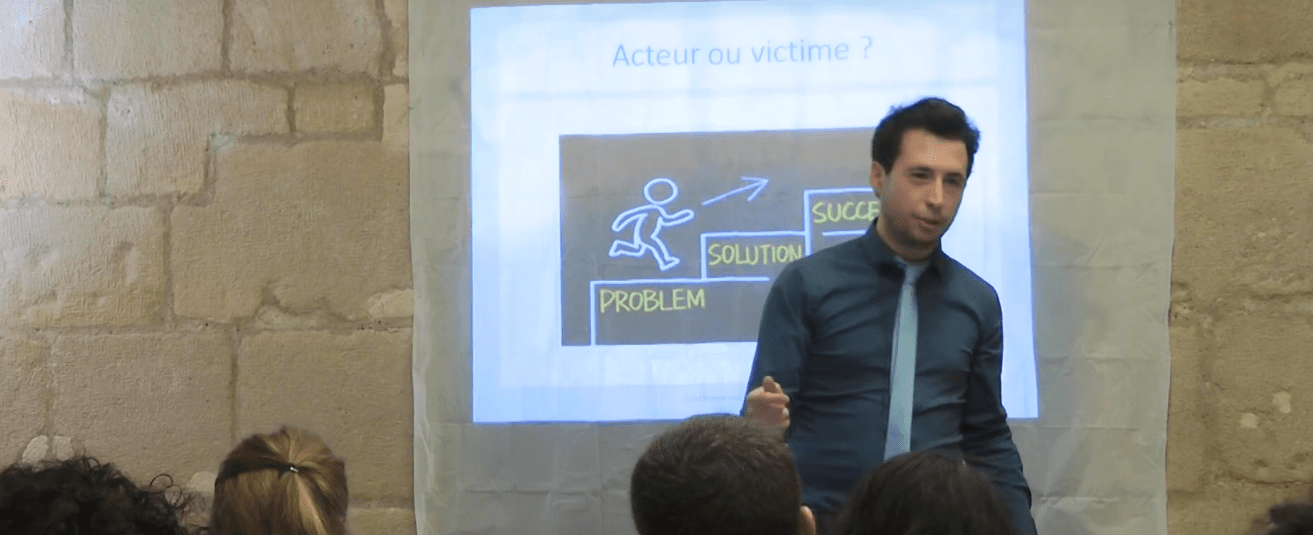
None of these levers asks you to work more hours.
They change what goes through your hands.
Delegate decisions, not only tasks
Most leaders delegate tasks, then remain the only person allowed to decide.
The team does the work and waits for your approval, so the pressure comes straight back to you.
Start by listing the decisions that land on your desk in a typical week.
For each one, ask yourself who could take it, within which limits, and when you would check the result.
Hand over one category of decisions at a time, with the expected result clearly stated.
You will lose some control over the details, and you will gain hours for what only you can do.
If you want to delegate decisions without lowering the quality your clients expect, it is exactly the kind of situation we can work on together.
Make your sales visible every week
Uncertainty is one of the main fuels of business owner stress.
A simple weekly dashboard is often enough to replace vague worry with facts: meetings booked, quotes sent, quotes signed, revenue expected over the next three months.
When you can read your pipeline in five minutes, you no longer need to carry it in your head.
These indicators also show you where to act: more prospecting, better discovery meetings, or firmer follow-up on the quotes already sent.
Protect time to work on your company
Leaders often tell me they work in their company instead of working on it.
Block a fixed slot every week for strategy, and treat it like a meeting with your most important client.
This is the time to decide what you stop, what you delegate and where you look for growth.
I explain in another article, in French, why deciding less is often what unlocks growth.
Stop deciding alone
Loneliness is not a detail, because it distorts decisions.
Without anyone to challenge you, you keep the same blind spots and you postpone difficult choices.
A group of peers, a mentor or a coach gives you a space to think out loud, with someone who understands business realities and has no stake in your internal politics.
Asking for this kind of support is a leadership decision, not an admission of weakness.
Here is a summary of the most common sources of business owner stress I see, with a first lever for each one.
| Source of stress | What it costs your company | A first lever |
|---|---|---|
| Every decision goes through you | Projects wait, the team waits, your evenings fill up | List the decisions others could take and hand over one category at a time |
| Quotes waiting for an answer | Revenue you cannot forecast, cash worries | Check pain, urgency and difficulty before sending a quote |
| No reliable sales indicators | Every month feels like a gamble | Track meetings booked, quotes sent and quotes signed every week |
| Administrative overload | Hours lost on low-value tasks | Group admin into fixed slots, then delegate or outsource what you can |
| Hiring for technical skills only | Competent people who still bring every decision back to you | Assess autonomy and posture when you recruit |
| Deciding alone | Blind spots, choices postponed for months | Book regular time with peers, a mentor or a coach |
The engineer’s reflex that turns control into pressure
I notice a specific pattern in leaders with a technical background, and I recognise it all the more easily because I share their training.
They know how to do things well, and they find it hard to accept work done differently from the way they would do it.
Their reasoning often sounds like this: “If I don’t do it myself, it won’t be done properly.”
The consequence is predictable: they take back the tasks they delegated, the team becomes less autonomous, and their workload keeps growing.
The same reflex shows up in sales.
An engineer explains how the solution works, while the client wants to know what it will change for them.
Discussions drag on, quotes come back with a price objection, and the leader feels uncomfortable when announcing the price.
Working on posture means moving from the engineer who controls everything to the leader who sets the direction, and from the technician who explains to the salesperson who listens.
As an NLP practitioner trained in nonviolent communication, I also help leaders handle tense moments, such as announcing a price, turning down a request or setting things straight with an employee, with more calm.
If you want to announce your price calmly and sell without feeling guilty, we can talk about it in a first conversation.
When business owner stress becomes burn-out: signals to take seriously

Stress is not always negative: a deadline or an important negotiation can sharpen your focus.
The problem starts when it becomes chronic.
The World Health Organization describes burn-out as a syndrome linked to chronic stress at work that has not been managed successfully, with three dimensions:
- A feeling of exhaustion, of having no energy left
- Growing distance from your work, or cynicism about it
- A drop in your professional effectiveness
The WHO classifies burn-out as an occupational phenomenon, not as a medical condition.
If you recognise these signals over several weeks, or if your sleep and your health are affected, talk to your doctor or your occupational health service first.
Coaching does not replace medical care.
It works on the business causes of the pressure: organisation, delegation, sales and posture.
Frequently asked questions about business owner stress
What are the main causes of business owner stress in an SME?
In my experience, the main causes are organisational: the leader remains the company’s main salesperson, every decision goes through them, the sales pipeline is hard to read, and administrative work piles up.
The 2026 Ifop barometer for the Fondation MMA des Entrepreneurs du Futur ranks administrative and regulatory workload first, ahead of work overload and economic uncertainty.
How can a business owner reduce stress without working more hours?
The answer is to change what goes through your hands rather than how long you work.
Delegating decisions, reading your sales figures every week, protecting a fixed slot for strategy and discussing decisions with peers, a mentor or a coach all lower the pressure without adding hours.
When should business owner stress be taken seriously?
Take it seriously when exhaustion, distance from your work or a drop in effectiveness last for several weeks, or when your sleep and health are affected.
In that case, the first step is to talk to your doctor or your occupational health service.
Reducing business owner stress to grow your company with a clear head

If you run an SME, or if you moved from a technical role to a leadership one, you may have recognised yourself in some of these situations.
Here is what working on the causes of business owner stress allows you to achieve:
- Fewer decisions on your desk, and better ones
- A team that moves forward without waiting for your approval on every detail
- A sales pipeline you can read in five minutes
- A fixed time each week to work on your company, not only in it
- Price discussions and negotiations you lead without guilt
- Revenue that no longer depends on your presence in every meeting
This is the work I do as an HEC-certified executive coach, in my executive coaching sessions in Paris (page in French).
I also share its sales side in the negotiation courses I deliver through the training organisation Cegos, notably for SIAAP and CSTB in 2026.
If you stopped answering your phone for two weeks, which part of your revenue would still come in without you?
Does your company still need you for every decision, every sale and every problem?
I help business owners delegate for real, read their sales at a glance and get back to the strategist’s seat, so the pressure no longer rests on them alone.
Lead your company without carrying it alone
The first conversation is free, or call me on +33 7 83 22 52 42.

French executive coach for business leaders, with dual technical and sales expertise
Engineer by training, HEC-certified coach and Cegos trainer
Based in Paris, speaks French, Spanish and English
Phone: +33 7 83 22 52 42
Email: contact@coachingcommunication.fr
Sources for the business owner stress figures
- AG2R La Mondiale and Ipsos BVA, barometer on the mental health of leaders and employees in small and medium-sized companies, 307 leaders, fieldwork from 1 to 17 July 2026 (in French)
- Économie Matin, article on the 2026 barometer of the Fondation MMA des Entrepreneurs du Futur, carried out by Ifop among 1,000 leaders, published on 5 May 2026 (in French)
- Deloitte Insights, Well-being at Work survey 2024, 3,150 respondents, published on 18 June 2024
- Bluevine, small business burnout report, 781 owners in the United States, published on 19 May 2026
- World Health Organization, Burn-out an occupational phenomenon: International Classification of Diseases, 28 May 2019




0 commentaire